
Before You Adopt AI: Three Questions Every Asset Management Program Should Answer

For asset management leaders, maintenance and reliability professionals, and the engineers and executives who own risk and capital decisions, most organizations have moved beyond the question, “Should we use AI?” What leadership should now be asking is, “How do we use AI well, and when should we not use it?”
Asset failures in water treatment systems carry significant public health, environmental and regulatory consequences. Before AI gets folded into how your organization assesses condition, prioritizes work or plans capital spending, there are three questions that can guide your adoption of AI in the way you would adopt any other tool that touches critical infrastructure: deliberately, with attention to detail.
1. Do you understand AI?
AI is much older than most people realize. The term “artificial intelligence” was coined at the Dartmouth Conference, a summer gathering in 1956 organized by mathematicians, computer scientists and electrical engineers hailing from Dartmouth College, MIT and IBM.
AI is a category, not a single thing, and most of what gets called AI is a specific sub-type, nested inside broader ones, like a bullseye.
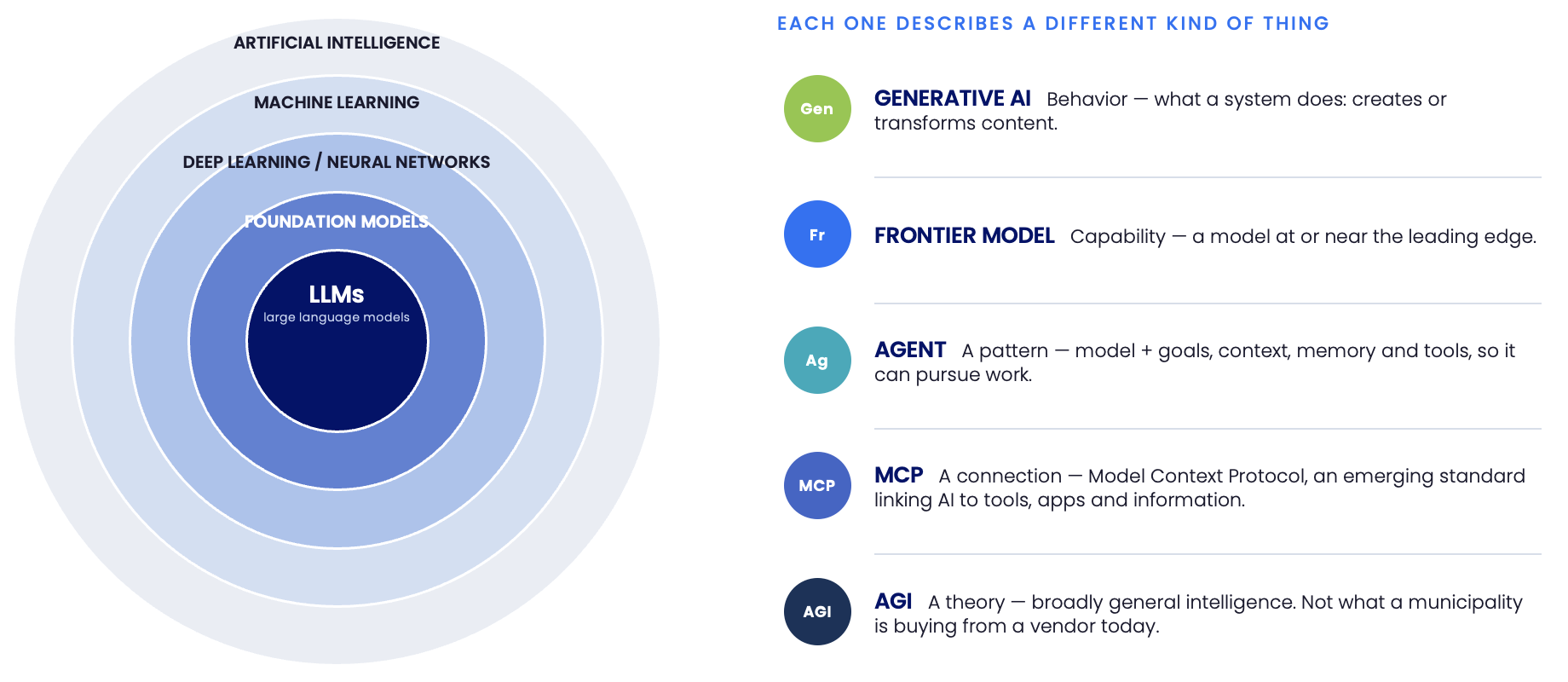
Artificial Intelligence is the most inclusive outer ring and refers to any system designed to perform tasks that normally require human judgment. The next smaller ring is Machine Learning, a system that improves a task by learning from data rather than following rules a person wrote line by line. Narrower still is Deep Learning, which uses layered, brain-inspired structures called neural networks to perform pattern recognition at massive scale, run on stacked warehouses of specialized computer chips. Closer to the center are Foundation Models: huge, general-purpose models trained on enormous datasets, built to be adapted to many different jobs rather than just one. And at the center of the AI bullseye are Large Language Models (LLMs), the foundation models trained specifically on text and language (what powers the chatbots and writing assistants most people now interact with daily).
These tools are pattern-matchers trained on historical data, running on enormous computing power, and they don’t “understand” your treatment plant the way an operator with 20 years of experience does. This is why human operators must always be able to grasp what an AI tool is actually doing with sensitive data, and what it’s basing its decisions on.
The bullseye explains the hierarchy of models, and Model Context Protocol (MCP) gives the models a standardized way to connect to external tools, data and systems. For example, MCP is what turns a chatbot into a tool that communicates with your systems.
It’s also important to understand this: A small handful of companies like Anthropic, OpenAI, IBM and Google (among others) are investing enormous computing resources to train foundation models from scratch. Most of the everyday tools showing up in asset performance management platforms are built on top of one of these foundation models, licensed or accessed through an API. The model is the engine. The application around it, typically provided by a third-party software vendor, decides where it goes, what it carries and who may drive. Two products can use the same model and create radically different value, and the same product can swap models and get very different answers.
2. Can AI deliver value?
With a firm understanding of how AI works and how a particular product will interact with your data, the next question is, “Can it deliver value?” The measure of a good AI tool is whether it fundamentally improves your workflow by collapsing multi-step processes, removing confusion, hurdles and friction, and letting the organization move faster with the same people. Value shows up as tangible gains, like lower execution costs, new capacity or the ability to perform work that used to be too expensive to justify.
As a real-world example, MentorAPM's MentorLens® tool lets field staff capture asset attributes and condition simply by taking photos, which get matched against standardized condition-score libraries instead of manually entered plate data. MentorLens can cut an assessment from $800,000 and seven months to as little as $80,000 and seven weeks, with more consistent scoring across sites and inspectors.
AI also can close the software adoption gap. Every organization has systems that are underused because logging in and navigating them is friction-filled; MentorAPM’s Nelson, an asset-aware AI co-worker currently in beta, lets users query and interpret asset data in plain language rather than digging through menus and reports, so the organization gets more out of software it has already bought. Both of these tools rest on MentorAPM’s asset data credibility: a foundation of accurate, quality data and the confidence that the information behind an operational or capital decision is complete, current, consistent and defensible.
Value loss prevention is another benefit AI can deliver. Most pointedly, this concerns the mass retirement of experienced staff members and their institutional knowledge. Water and wastewater utilities are facing a wave of attrition among operators who carry decades of plant-specific knowledge that was never written down, like valves that need babying and symptoms that precede specific failures. AI can help capture that institutional knowledge into a searchable, permanent system before it walks out the door (with a human still validating what gets codified).
Not every task should be turned over to AI. Some jobs are genuinely better served by a spreadsheet, a query or existing software reporting, and pointing an AI model at them doesn’t add value, it adds cost and risk for no real gain. Part of “Can AI deliver value?” is knowing when the honest answer is no.
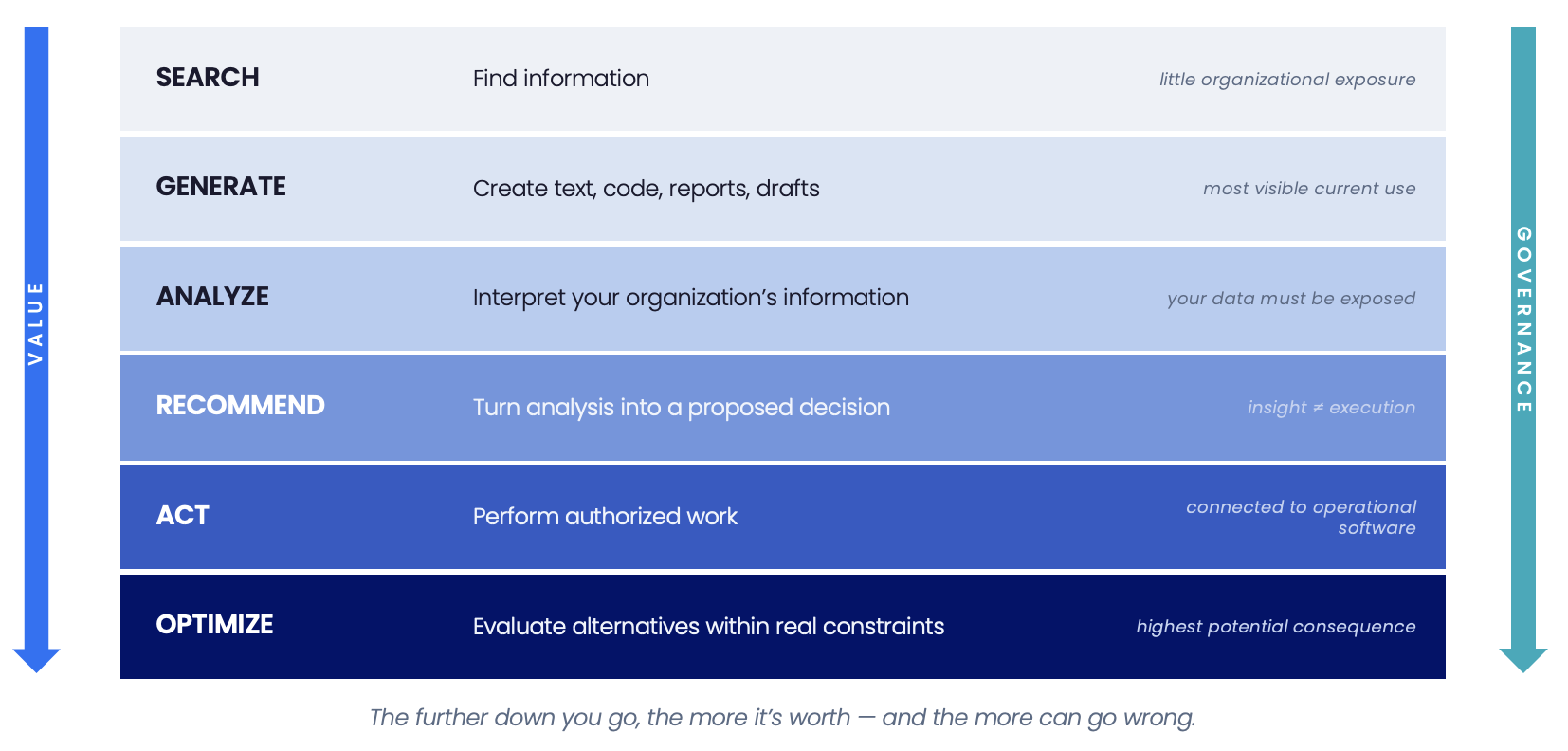
It also helps to recognize that AI’s value increases with the complexity of what you let it do. Using a municipal water example, in roughly increasing order of value:
· Search — Find the policy governing this expenditure.
· Generate — Draft the council briefing.
· Analyze — Compare actual capital expenditures against the approved plan.
· Recommend — Identify which projects deserve attention given risk, cost and available funding.
· Act — Create and populate the workflow, assign responsibility and route it for approval.
· Optimize — Continuously reconsider the capital plan as cost, condition, risk and funding constraints shift.
The deeper down this list a tool operates, the more value (and consequence) it carries. A tool that searches a policy document is not that risky if it’s wrong; the same cannot be said of a tool that optimizes your capital plan.
3. Is it governed enough to trust?
Mistrust in AI is in no short supply. Outcomes, however, are dictated by the governance wrapped around it, not by the model’s raw capability. The place to confirm trustworthiness is less in the model and more in the governance around the model.
Think of AI capability as an iceberg. Above the waterline is an impressive model that can churn out a polished condition report from field photos or draft a convincing capital plan narrative. None of this picture tells you if the model safeguards your customer data, asset information or capital plan. Below the waterline are the controls, protocols and shields that actually determine whether an AI tool can be safely adopted in the organization’s asset management program.
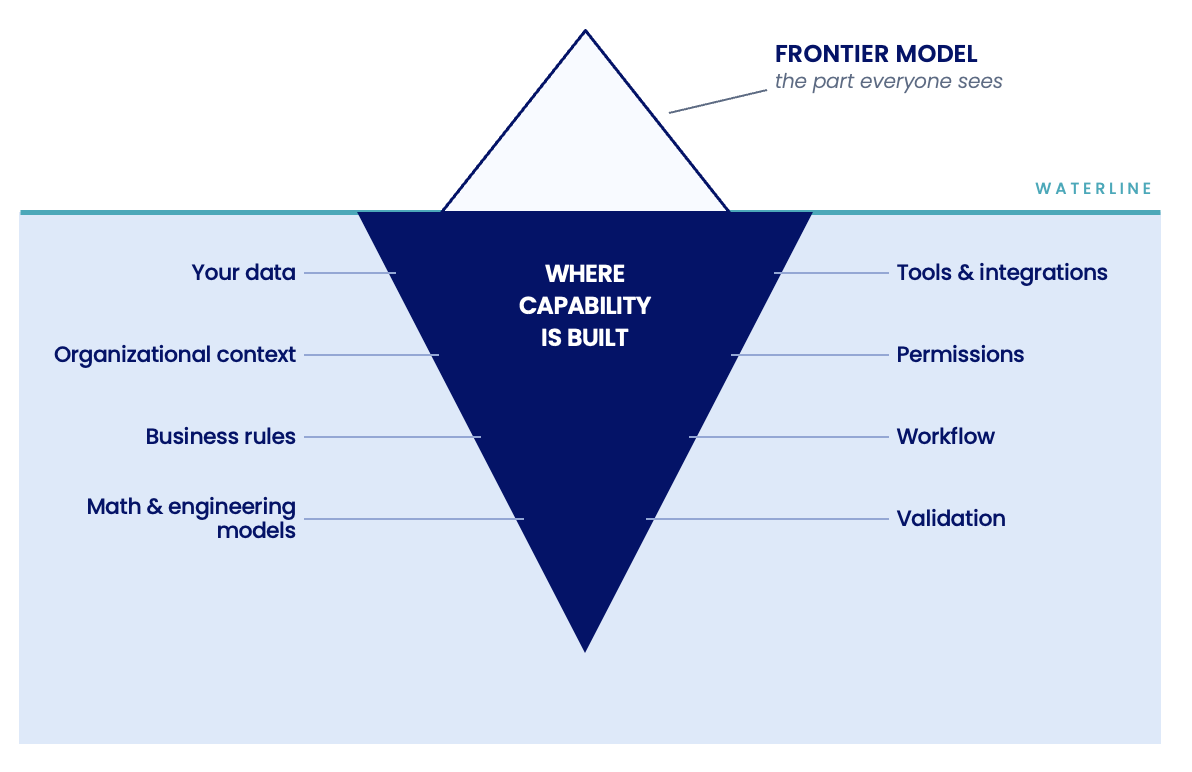
In practice, that governance takes a few concrete forms:
Controls and guardrails. AI shouldn’t be given free rein to choose its own methodology. For consistency and accuracy, it should be gated to specific, approved formulas and first principles, forced to work from a given rubric rather than inventing its own logic. That extends to data sources: letting a model scrape the open web for reference images or figures (like for condition assessment) invites inconsistent, unverified data into decisions that depend on reliable inputs. Access should be limited to sanctioned datasets and readouts. Permissions should be role-based, in the same way you would manage any co-worker’s access. What the AI is allowed to touch should depend on who is logged in and what they are authorized to do.
Another guardrail is not relying on a single model's answer. Running the same task across a minimum of three independent frontier models and requiring them to agree before an output is trusted is a technique borrowed from industrial process control, where critical systems rarely rely on a single sensor reading. Applied to condition assessment, a three-model consensus approach can catch the false positives and false negatives a lone model would often miss, giving the organization confidence that the answer is repeatable, not just plausible.
Cybersecurity and data protection. The clearest failure mode is sensitive municipal, corporate or personal data leaking out through a third-party AI tool into the open web. Vendors should be vetted with the same rigor as any system touching your data and required to supply evidence of penetration testing, secure architecture and contractual protections, not just assurances.
Beware of DIY’ing your AI. A technically inclined employee can now stand up a working AI application over a weekend using consumer tools, and if it starts touching plant or customer data, that convenience becomes an immediate liability. No one else understands how it works; there's no support plan if the creator leaves, and it was never properly vetted for the security exposure it creates. This doesn’t mean you have to bar your engineers from experimenting, but AI tools created in-house should receive the same oversight as every other system that touches critical infrastructure or customer data.
Auditing and human control. Nothing should run in secret. Every single action an AI takes should be logged, and documentation should easily allow the organization to trace back to why a decision happened. And no matter how capable the tool becomes, a human retains the final say with built-in human override.
The point of strong governance and controls is to make sure that when AI does deliver value, it does so in a way the organization can trust and explain to a regulator, a board or the public it serves.
None of these three questions has a permanent answer.
The tool you understand today will be a different tool in a year. The workflow it improves now will be the future baseline. The governance that’s sufficient for a pilot may not be sufficient at scale. These are not reasons to wait on AI but to commit to the practice of asking and reviewing regularly. Every time a new AI capability shows up in your asset management ecosystem, run it back through the same three questions: Do I understand it? Does it deliver value? Is it governed enough to trust? Asset management has always been about managing risk deliberately, asset by asset, decision by decision. AI doesn’t change that discipline, it just gives you a powerful new tool for execution.

Connect with Us

